
Jev AI Model: 22 Viral Use Cases and Real-World Applications

You may have encountered tasks like these: testing games, searching for real-world flight information, reviewing the security of user commands, classifying large volumes of business emails, or routing customer support tickets to the right team. These tasks are not particularly complex, but they often require countless small decisions to be made quickly and consistently.
The problem is that as these repetitive decisions scale, the costs can quickly add up. Using a powerful large language model (LLM) for every simple classification or routing task not only increases costs and response times, but also consumes resources unnecessarily. Yet these tasks are essential—they. They form a critical part of many AI workflows. This is where Jev model comes in. As a lightweight decision layer, the Jev model makes these repetitive decisions faster and more efficient.
What Exactly Is the Viral Jev AI?
Traditional large language models are fundamentally generative: when you ask them a question, they generate an answer one token at a time. This mechanism works exceptionally well for content creation, logical reasoning, and coding, but when it comes to handling simple choice-based tasks, it can be unnecessarily heavy, expensive, and slow.
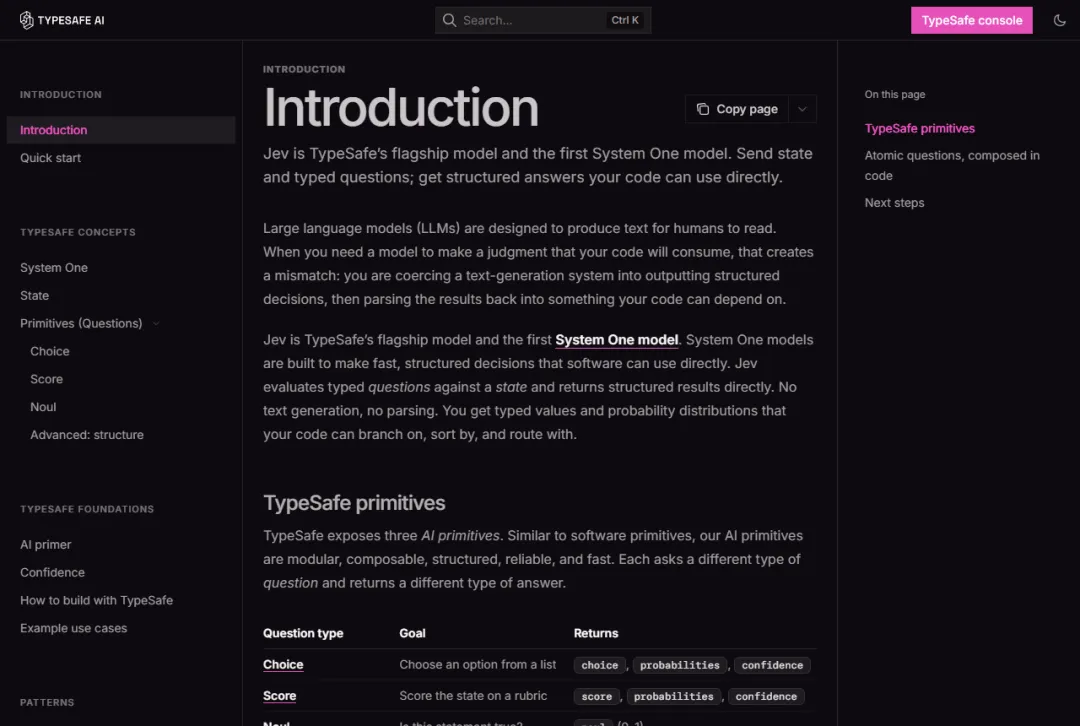
Jev takes a fundamentally different approach. It is a lightweight classification and scoring model. With each call, you simply provide a piece of context along with a clearly defined set of options. Jev model then directly outputs a probability distribution across those options and selects the one with the highest confidence. Its response latency ranges from just tens to hundreds of milliseconds, while its cost is only a fraction of that of mainstream large language models.
An introduction post published by founder Diogo Almeida on X has already received 36.2 million views. What has attracted widespread attention is not just its low cost, but the fact that Jev model fills a critical gap in agent workflows: a low-latency decision-making control layer.
22 Viral Ways to Use the Jev AI Model
1. Official: Real-Time Doom Gameplay
In an official launch demo, Jev AI model was used to play the original Doom in real time. Jev made around 10 action decisions per second, controlling the character’s movement and firing. Running continuously for an hour cost approximately $7—lower than engineers had expected—demonstrating the feasibility of high-frequency, real-time decision-making.
2. Official: Wikiracing with Thousands of Choices
Starting from one Wikipedia article, the model navigates to a target article using only hyperlinks on each page. At every step, it may face hundreds or even thousands of candidate links, and Jev model must select the one that is semantically closest to the target. The test demonstrates how the Jev model handles a large number of choices without relying on free-form generation.
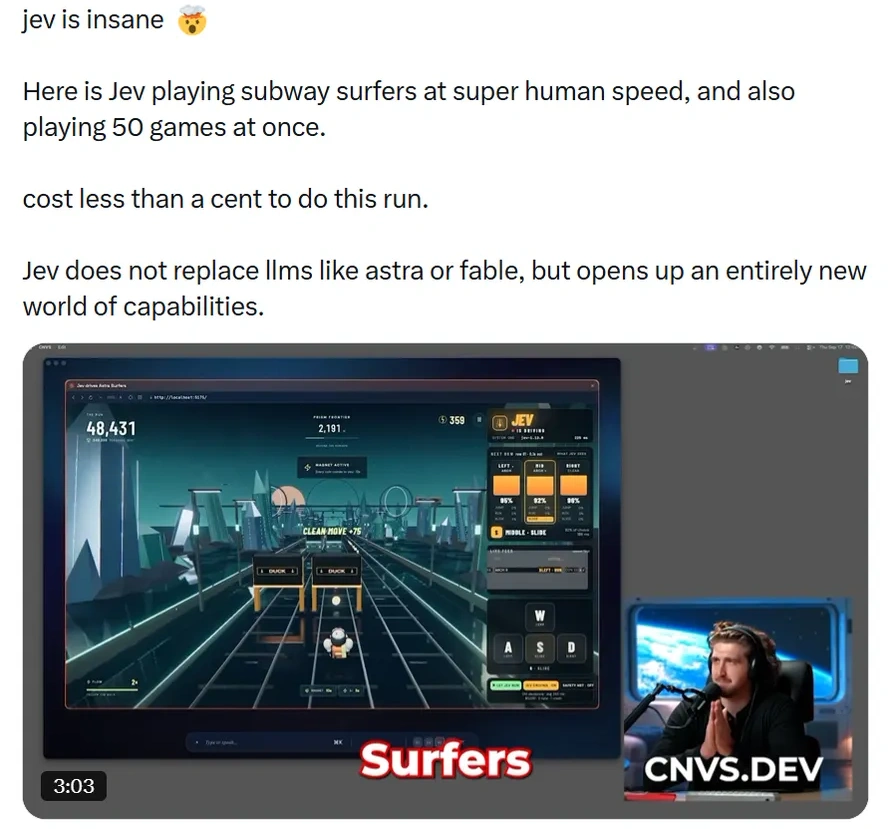
3. Running 50 Subway Surfers Games Simultaneously
Developer @_MaxBlade built an automated environment in which the Jev model controls 50 simultaneous Subway Surfers games. Lane changes, jumps, and slides each require a small decision, causing the number of calls to quickly add up. Even so, the total cost of completing all 50 runs was reportedly less than one cent.
4. Open-Source Super Mario Controller
Developer @faadilhshaik built a Jev-powered controller for the classic Super Mario. The system reads structured game-state data directly from memory, while the Jev model decides when to jump and accelerate. The project has been open-sourced on GitHub.

5. Speedrunning Slay the Spire 2
Chinese developer paulwei used Jev model to play the strategy card game Slay the Spire 2. Earlier attempts using larger language models introduced noticeable delays between moves. After switching to Jev, each card-play decision reportedly took just 0.7 seconds, allowing the next command to be issued before the previous animation had even finished.

6. Autonomous Driving in a 3D City Simulation
Developer @jpschroeder integrated Jev AI model into a 3D city simulation. As the vehicle drives through virtual streets, Jev uses sensor data and road conditions to determine the direction of travel. After each movement, the updated state is fed back into the system. The entire setup reportedly took less than an hour to build.

7. Rocket Landing with MuJoCo Physics Simulation
Developer @uttkarsh_42 used Jev model with the MuJoCo physics engine to control a vertically landing rocket. Jev determines when to fire the engines, how many engines to activate, and when to switch the landing posture. After 12 trials, the system successfully landed, with one complete trial using 245 calls at a reported cost of around $0.04.
8. Pixel-by-Pixel Image Generation
Developer @anshuc turned image generation into a pixel-level classification problem. Each pixel is assigned a set of color options and probabilities, and the program progressively fills the image using the highest-probability colors selected by Jev, producing a complete low-resolution image.
9. Browser Use's Official jev-ultrafast Integration
The Browser Use team released the official jev-ultrafast integration just three days after Jev AI launched. The project reportedly gained 2,700 GitHub stars within two days. It represents web actions as two sets of choices—an action and a target—without screenshots or multimodal tokens, producing two decisions per round trip.

10. Real-World Flight Search in 7 Seconds
Browser Use founder Gregor Zunic shared an unedited demonstration in which Jev-powered browser automation completed a one-way flight search on a real airline website. The entire process took 7 seconds and reportedly cost just $0.0039 in model calls.

11. Vercel's Shell Command Security Classifier
Vercel engineer Pranit Sharma replaced an OpenAI-based internal Shell command security classifier with Jev AI. Processing speed reportedly increased by 5–18×, while lower false-positive rates actually improved the system’s practical accuracy.
12. High-Volume Business Email Classification
BryoAI CTO Nikhil Mudholkar compared Jev AI with Gemini for business email intent classification. Gemini had a slight advantage in absolute accuracy, but each call reportedly cost 10–20× more. More importantly, Jev AI provides calibrated probability distributions, making it easier for downstream systems to set confidence thresholds.
13. Ticket Assignment and Automated Routing
In customer support workflows, incoming tickets can be summarized into key information and passed to Jev. The model then selects the most appropriate team from a set of business groups, replacing fragile hand-written regular-expression rules.
14. Automated Pull Request Pre-Screening
Within a CI pipeline, Jev model can analyze the list of changed files and automated test results to make an initial assessment of whether a pull request is ready to merge. High-risk PRs can be automatically flagged for human review.
15. Duplicate Charges and Urgent Support Classification
For financial and e-commerce workflows, Jev AI can quickly identify high-risk customer complaints, such as duplicate charges. When a customer appears highly frustrated or requests a refund, the system can assign an urgency label within milliseconds and prioritize the case for a human support agent.
16. jev-mcp for Fact Checking and Injection Detection
The community has also open-sourced jev-mcp, an extension based on the Model Context Protocol (MCP). Developers can use Jev for cross-source fact checking, detecting potential prompt-injection attacks hidden in user prompts, and scoring the semantic relevance of retrieved content.
17. fast-jev-compaction for Long-Context Management
As Coding Agents work on longer tasks, their context can quickly become bloated. fast-jev-compaction uses Jev to quickly assess the value of each tool call and remove unnecessary logs while preserving important state. The project has also received recognition from the official Jev team.
18. Jev Codex Router for Task Difficulty Routing
A multi-model routing project uses Jev AI model to estimate the logical complexity of a coding task before execution. Simple edits are routed to cheaper models, while complex cross-file refactoring activates more capable models. The project reportedly reduced overall model costs by more than 60%.
19. Upstream Model Routing
Armin Ronacher, CTO of Earendil and founder of Sentry, has argued that using mainstream generative LLMs to make routing decisions can be economically inefficient. Jev’s low latency and low cost make it possible to deploy high-density, real-time traffic routing at the application entry point.
20. LangChain: Jev as an Agent Decision Layer
LangChain published a dedicated article, Building a Harness with Jev, arguing that classification and routing logic in Agent frameworks has traditionally been buried inside custom, closed-source implementations. A general-purpose, low-cost classification model like Jev could make this decision layer reusable across open-source Agents.

21. Automated On-Chain Order-Book Trading
Some Web3 developers have connected Jev AI to decentralized exchanges. The model reads real-time order-book depth data and outputs only three possible actions: buy, sell, or hold. While the community sees this as one of the more eye-catching applications, it also carries significant risk in real-world market conditions.
22. PrimeLine Pre-Registered Benchmark: When Confidence Matters
In a double-blind, pre-registered evaluation conducted by PrimeLine, Claude Opus 5 and Haiku 4.5 reportedly matched or initially outperformed Jev in absolute accuracy on two real-world tasks. However, when the evaluation allowed models to skip samples they were least confident about, Jev reportedly came out ahead on both tasks. The difference was attributed to Jev’s calibrated confidence scores, while general-purpose generative models can be poorly calibrated and overly confident in their self-assessments.
Tips for Using Jev AI model
For engineers building AI agents, two key takeaways stand out. First, don’t expect a small model to provide unlimited, open-ended reasoning. Its strength lies in turning decisions into a clearly defined set of finite options, enabling fast, consistent, and high-throughput classification.
Second, when a workflow involves non-generative tasks such as safety filtering, request routing, or ticket assignment, replacing a heavyweight large language model (LLM) with a lightweight decision model can significantly reduce costs while bringing response times down to practical, millisecond-level speeds.
How to Get Started with Jev?
If you're wondering where you can start using Jev directly and what official developer tools are available, the good news is that access has already been opened through both the official platform and major model aggregation gateways within its first week.
Official Console and Documentation
TypeSafe provides an online console (Playground) along with comprehensive developer documentation. You can make requests directly through the HTTP API, Python SDK, or JavaScript SDK. Input is priced at $0.042 per million tokens, while output is free.
OpenRouter and Vercel AI Gateway
If you already use an existing model aggregation layer, there’s no need to apply for a separate SDK:
-
OpenRouter: Jev is already available in its official model catalog under the model ID
typesafe/jev. If you already have OpenRouter integrated into your codebase, you can switch to Jev simply by changing the model name. -
Vercel AI Gateway: Direct integration was completed within 72 hours of Jev’s release, providing low-latency distribution through Vercel’s global edge network.
Official Skills Package: Help Agents Ask Multiple Questions at Once
Beyond the basic API, TypeSafe has also open-sourced the typesafe-ai/skills repository on GitHub. It provides a set of capability specifications designed specifically for Coding Agents.
The package addresses an inefficient habit common among agents: asking only one question at a time. When faced with ambiguous requirements, it guides the agent to identify all potential points of ambiguity at once and present them together with a set of candidate options.
From the buzz Jev generated on Twitter on its very first day to its integration into various production-grade workflows within just a week, Jev has given the developer ecosystem a practical lesson in the value of specialization.
At its core, Jev is a fast and cost-efficient classifier that can serve as a lightweight decision layer within AI pipelines. It can handle tasks such as routing, agent orchestration, and content moderation, helping reduce both latency and processing costs. But Jev is a specialized decision model, not a replacement for general-purpose large language models (LLMs). Its value lies in doing one thing particularly well: making fast, reliable decisions when the possible outcomes are clearly defined.
FAQ
What is Jev AI?
Jev AI is an independent playground and API for Jev, the System One model from TypeSafe. You give Jev a piece of text and typed questions; it returns yes/no probabilities, choices and scores with calibrated confidence.
How much does Jev AI cost?
New accounts get 5 free credits for the playground or the API, one per run or call. Purchased credits pay by actual input tokens across playground, batch, API and AI judge generation: 1 credit per million input tokens. Credits come from the monthly plans or one-time packs on the pricing page.
What People Are Building with Jev AI?
Developers are using Jev AI for fast, structured decision-making across coding agents, intent recognition, real-time recommendations, invoice processing, and visual classification.
How does the Jev API on this site work?
Create an API key on the Jev API page and send the same JSON you would send to TypeSafe (state, model, questions) to Jev AI. Free credits (welcome and daily check-in) are used first at one per call; purchased credits are billed by input tokens.
Is Jev AI affiliated with TypeSafe?
No. Jev AI is an independent service that is called the official TypeSafe API. Jev and TypeSafe are names of their respective owners.